The Silent Coup: Why Citizens United is the "Genocide" of American Democracy
Are we currently in genocidal times in our United States? One may say "no" but are they correct? Are they viewing this as a race issue? If so they are wrong. The genocide of the American People crosses race, class and religion lines, but no one is speaking on this, why?
POLITICSBUSINESS
t.furgeson
2/3/20264 min read
Citizens United v. FEC (2010)
The case began when a conservative non-profit group called Citizens United wanted to air a documentary critical of Hillary Clinton right before the 2008 primary elections.
At the time, the Bipartisan Campaign Reform Act (BCRA) prohibited corporations and unions from using their general treasury funds for "electioneering communications" (political ads) within 30 days of a primary or 60 days of a general election. The FEC blocked the film, and Citizens United sued, claiming their First Amendment rights were being violated. Because of this ruling, organizations can now raise unlimited sums of money from corporations, unions, and individuals to spend on ads that support or attack candidates. As long as they don't "handshake" with the campaign on strategy, there is no ceiling on the spending.
The ruling:
In a 5-4 decision, the Court ruled in favor of Citizens United. The majority opinion, led by Justice Anthony Kennedy, rested on a few key pillars:
Money is Speech: The court argued that spending money to promote a political message is a form of protected speech.
Corporate Personhood: The court maintained that the First Amendment protects "speech," regardless of whether the speaker is a person or a corporation.
Anti-Corruption Argument: The justices argued that as long as the spending is independent (meaning the company doesn't coordinate directly with a candidate's campaign), it doesn't pose a threat of corruption.
The floodgates finally burst, the rise of the Super-PAC
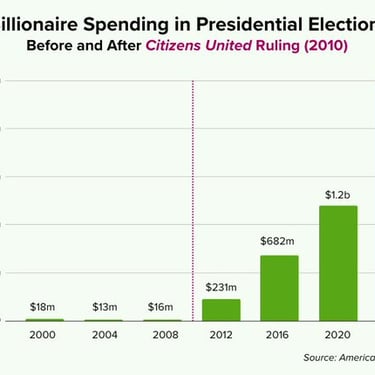
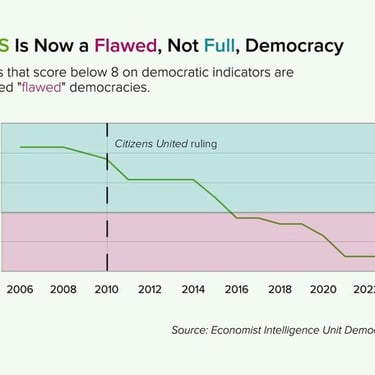
Since the Citizens United ruling in 2010, the landscape of political donations hasn't just grown—it has undergone a tectonic shift. While direct donations to candidates' campaigns are still capped by law, the money flowing into elections through "outside" channels has exploded.
Since the ruling the the amount of donations to campaigns have risen drastically, exploding out of the roof. For example:
Midterm Outside Spending (Before 2006/2008) - $38 million(2006) vs $1.1 Billion in 2018 - a 2,800%+ increase!
Presidential Outside Spending (Before 2006/2008) - $144 million (2008) vs $1.3 billion+ 2012-2024 - a 800%+ increase.
Note: In the 2024 cycle, billionaire spending alone reached over $2.6 billion, accounting for nearly 20% of all federal election spending.(per the Roosevelt Institution)
Source: The Roosevelt Institution
While Citizens United didn't transform the political landscape overnight, its ripple effects fundamentally altered how American elections are financed. By striking down bans on corporate and union spending, the Supreme Court didn't just change one rule; it dismantled the very foundation of campaign finance regulation.
The Legal Shift
The ruling’s true power lay in its narrow definition of "corruption." By deciding that only direct quid pro quo bribery counted as a threat to democracy, the Court effectively shielded most political spending under the umbrella of First Amendment free speech. This logic made it nearly impossible for states or Congress to limit election spending without facing immediate legal defeat.
The Rise of Super PACs and "Dark Money"
The legacy of Citizens United is most visible in two specific areas:
Super PACs: Building on the Citizens United logic, the
(2010) ruling allowed for the creation of political action committees that can raise and spend unlimited funds. While they aren't allowed to coordinate directly with candidates, their financial power is virtually unchecked.
Shadowy Transparency: Although Super PACs are legally required to report their donors to the FEC, the system is easily bypassed. Wealthy donors often use "dark money" groups—like 501(c)(4) nonprofits—to funnel cash. Because these nonprofits aren't required to reveal their contributors, the original source of the money remains hidden from the public.
In short, the ruling shifted the focus of political power away from regulated individual contributions and toward a complex, often invisible network of unlimited independent spending.
The Erasure of the Individual
Democracy rests on a singular, sacred premise: one person, one vote. This principle ensures that the garment worker in Ohio and the billionaire in Manhattan hold equal standing in the eyes of the state.
Citizens United effectively executed this principle. By reclassifying corporate spending as "protected speech," the Court gave the wealthiest entities in the world a megaphone so loud it drowned out the voices of 330 million individuals. When money equals speech, those without it are, by definition, silenced. This isn't just a policy shift; it is the systematic eradication of the individual's role in governance.
Source: The Roosevelt Institution
The Redefinition of Corruption
Perhaps the most damaging aspect of the ruling was its radical narrowing of what constitutes "corruption." The majority opinion argued that unless a politician is caught in a literal, documented quid pro quo (this for that) exchange, no corruption exists.
"Influence and access... are not corruption." — Justice Anthony Kennedy
This logic ignores the reality of human nature and political influence. When a Super PAC spends $50 million to elect a Senator, that Senator does not need a written contract to know whose interests to prioritize. By legalizing "influence-buying," the Court didn't just invite corruption; it institutionalized it, killing the public's trust in the integrity of the ballot box.
The Rise of the "Dark Money" Shadow State
The fallout of the ruling led to the birth of Super PACs and the weaponization of 501(c)(4) "dark money" groups. These entities allow anonymous billionaires and massive corporations to pour billions into attack ads without the public ever knowing who is pulling the strings.
This lack of transparency has created a "shadow state" where:
Voters are manipulated by high-production propaganda funded by unknown interests.
Legislative agendas are written by lobbyists for the donors who funded the latest Super PAC blitz.
Accountability is impossible because the trail of money is intentionally obscured through complex financial shells.
Conclusion: A Republic in Name Only
A democracy cannot survive when its leaders are more accountable to their donors than to their constituents. By granting corporations the rights of people without any of the responsibilities, the Supreme Court fundamentally altered the DNA of the American experiment.
The "genocide" of our democracy is not a single event, but a lingering process—the slow displacement of the will of the people by the weight of the treasury. Until the legal fiction that "money is speech" is overturned, the American Republic remains a government of the donors, by the donors, and for the donors.